quality Process Control
From raw materials to finished products, we implement full-process control over production to ensure strict consistency from samples to batches.
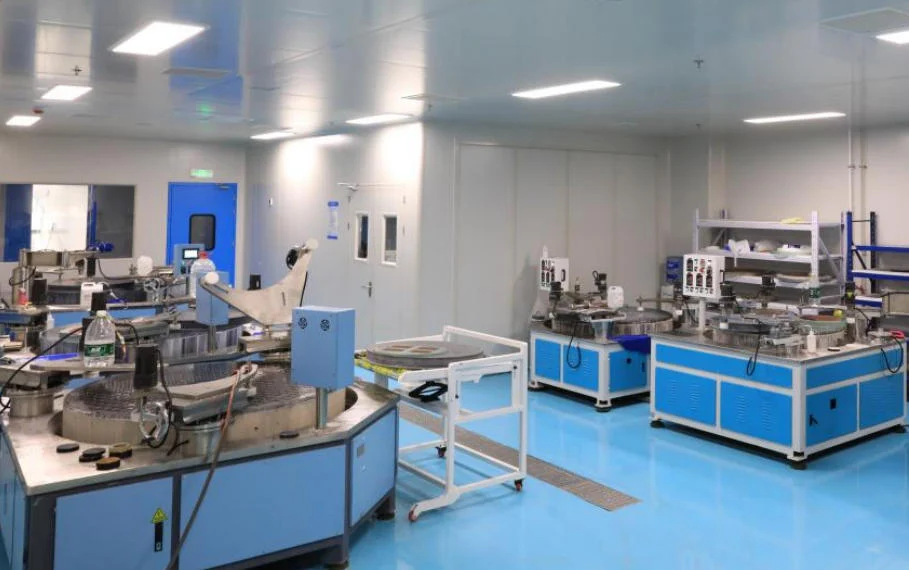
Environmental Control
We employ Class 100 cleanroom standards for ultra-smooth surface processing, polishing, and coating. Assembly and processing areas utilize Class 1000 to Class 10000 cleanroom standards. Furthermore, we maintain a year-round constant temperature and humidity environment, with the temperature controlled at 22°C ± 0.5°C and humidity at 45% ± 5% RH. This eliminates the impact of temperature variations on the surface precision of optical components, ensuring the stability of equipment and materials.
Materials Management
We maintain long-term partnerships with top global optical material suppliers such as Schott, Ohara, Hoya, and Corning. We also collaborate with high-quality domestic and international suppliers of crystals and infrared materials to ensure batch-to-batch stability.
Each batch of raw materials must pass tests for refractive index, transmittance, bubbles, impurities, stress birefringence, and geometric dimensions to meet acceptance standards before being put into storage.

Processing Technology
We possess a complete process chain covering rough machining to ultra-precision polishing, and can select the optimal process according to different product types (spherical, aspherical, freeform, ultra-smooth) and precision requirements.
| Chemical Mechanical Polishing (CMP) | Single/Double-Sided Polishing Machine | Crystals, Silicon Wafers, Ultrat-smooth Surfaces |
| Magnetorheological Finishing (MRF) | Deterministic Polishing Equipment | High-Precision Aspheres and Freeform Surfaces |
| Ion Beam Polishing (IBF) | Vacuum Ion Beam Equipment | Ultra-high Precision, Subsurface Damage Elimination |
| Robotic Polishing | Industrial Robots | Medium-to-Large Aperture Optical Components, Complex Surfaces, Freeform Surfaces |
Traceability
Each optical component, from raw material to finished product, possesses a unique traceability ID that runs through all processes. This includes:
Raw Material Inbound
A batch number is generated, recording the material source and IQC data.
Process Flow
The ID is scanned at each process stage, recording operators, equipment, process parameters, and inspection data.
Inspection Archiving
All inspection results are linked to the ID and stored in the database.
Finished Product Outbound
The ID is printed on a label or accompanied by a COA report.
Therefore, the complete processing history of any component can be queried, and traceability back to the raw material batch and process conditions is possible.
Typical Tolerance Range: Demonstrating Capability with Data
Below are our commonly achievable tolerance ranges. For special requirements, these can be further tightened.
Through rigorous control at every stage, we have established a complete and stable output system encompassing environment, materials, processes, and testing. Whether you require ultra-smooth windows for high-power lasers, aspherical mirrors for space optics systems, or any optical component with stringent process control requirements, our process team will work with you to define the manufacturing plan, ensuring that every batch and every component meets your expected quality standards.