Custom Superpolished Fused Silica Prisms Ra0.1-0.2nm
Ultra-smooth fused silica prisms are high-precision prisms whose working surfaces achieve sub-angstrom-level surface roughness. These ultra-smooth prisms play key roles in laser systems for beam folding, beam splitting, and dispersion. Surface scattering is a critical factor affecting the signal-to-noise ratio. Asin Optics manufactures and customizes low-scatter prisms, controlling surface roughness to the 0.1 nm level, thereby minimizing energy loss during the total internal reflection process
Superpolished Fused Silica Prism Product Overview
We currently offer custom manufacturing services for a wide range of super-polished prisms. Asin Optics’s super-polished fused silica prisms are manufactured using high-purity UV-grade fused silica. Our super-polished fused silica prisms achieve surface roughness at the sub-angstrom level. Their extremely low scattering values and high laser damage thresholds ensure highly precise refraction and reflection in laser systems, while maintaining exceptionally high reflectivity.
Types Of Superpolished Fused Silica Prism We Offer
We currently offer a wide range of superpolished fused silica prisms, including:
- Right-angle prisms
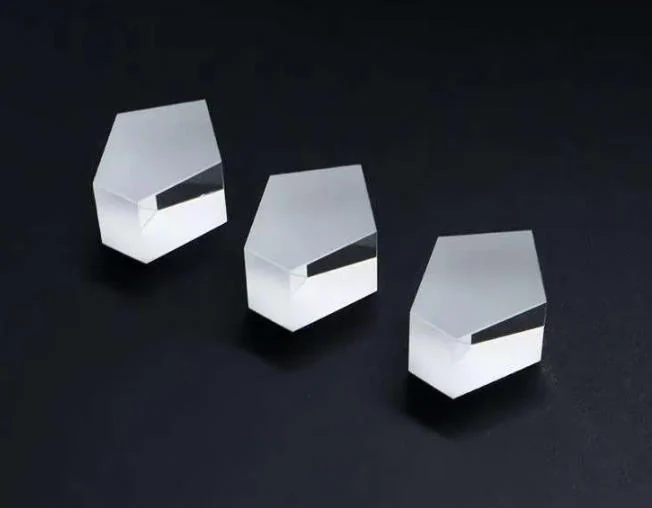
- Pentagonal prisms
- Dispersion prisms
- Beam-splitting prisms
Superpolished Fused Silica Prism Advantage
- Our superpolished fused silica prisms achieve a stable surface roughness of Ra ≤ 0.2 nm on all optical faces, delivering near-zero scattering and preserving a clean, pure laser spot even in deep-UV and high-power laser applications.
- We use high-purity fused silica as the substrate, which offers exceptionally high transmission across the 185–2100 nm range. In addition, the thermal expansion coefficient of fused silica is practically zero, so angular pointing and surface figure remain virtually unchanged when the temperature varies.
- Angular accuracy can be controlled to ±1 arcsecond, pyramidal error to less than 1 arcminute, and surface figure accuracy to λ/30. This ensures that beam deflection and dispersion angles are exactly as designed, with almost no outgoing wavefront distortion.
- We also provide coating services. Superpolished prisms can be supplied with broadband AR coatings, narrowband AR coatings, partial reflectors, or protective dielectric coatings. All coatings are fabricated to meet high laser-induced damage thresholds.
Superpolished Fused Silica Prism Technical Specifications
Custom Capability Of Superpolished Fused Silica Prism
Why Choose Asin Optics For Your Sub-angstrom Surface Roughness Prisms
- . Conventionally polished optical components can only achieve 10 Å to 15 Å RMS roughness. Asin Optics achieves Ra 0.1 nm fused silica prisms. With simultaneous control over surface finish and subsurface damage, lower scatter in high-power laser systems directly translates to higher transmitted energy and reduced stray light.
- λ/30 PV surface figure prisms preserve wavefront shape while minimizing scatter to the greatest extent possible.
- High-purity UV fused silica, manufactured with sub‑angstrom surface finish, ensures high laser‑induced damage threshold (LIDT) under temperature variations and across nanosecond, picosecond, and other high‑performance laser systems. This defines our High LIDT UV fused silica prisms.
- Whether right‑angle prisms, penta prisms, or Dove prisms—nearly all geometries are available with 0.1 nm Ra surface roughness and λ/30 surface figure, ensuring that transmitted wavefront and image quality are optimally satisfied.
Lower Scatter Fused Silica Prisms Applications
-
Laser Ring Gyroscopes
In ring laser gyroscopes, backscatter is one of the primary sources of error. Optical scattering caused by surface roughness leads to mode coupling. Conventionally polished prisms, with their inherent scattering levels, impose a fundamental limit on gyroscope accuracy. Superpolished prisms, featuring ultra‑low surface roughness, significantly reduce backscatter. Combined with high‑precision surface figure that ensures minimal wavefront distortion within the resonant cavity, these prisms enable the gyroscope to maintain sensitive response even at extremely low angular rates.
-
Deep UV Lithography
Deep UV lithography demands optical systems with extremely low scattering losses and exceptionally high wavefront quality. As a result, the optical components must be highly insensitive to absorption and subsurface damage when exposed to deep UV radiation. In the UV illumination system, low‑scatter penta prisms and right‑angle prisms are employed for beam steering, homogenization, and beam splitting.
-
Optical Contacting
Optical contacting is an adhesive‑free bonding technique. It involves bringing two ultra‑smooth, flat optical surfaces into direct contact so that they permanently bond through intermolecular van der Waals forces (or hydrogen bonding). The process consists of rigorously cleaning and activating the contact surfaces of two superpolished prisms. The intermolecular forces then create an “optical contact” at the interface, forming a strong, permanent bond without the need for any adhesive or high temperature.
FAQ:
Q1: How do you measure Ra values between 0.1 nm and 0.2 nm?
A1: We primarily use AFM (Atomic Force Microscopy) and the Zygo Newview white light interferometer to perform the measurements. Every prism is shipped with a data analysis report included.
Q2: Can you deposit IBS coatings on your superpolished prisms?
A2: Yes, we can. IBS (Ion Beam Sputtering) coatings are highly dense and pinhole‑free, enabling ultra‑low absorption and ultra‑high reflectivity.
Q3. While achieving a superpolished surface, how do you maintain the prism’s angular tolerance?
A3: Using our proprietary polishing technology, we can superpolish the working surfaces of the prism without compromising angular accuracy. The angular tolerances are then verified with a high‑precision goniometer.