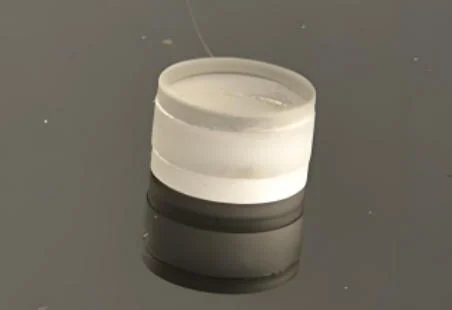
Fused Silica Achromatic Triplet Lenses Product Discription
In traditional cemented doublets, material dispersion limitations make it impossible to simultaneously correct spherical aberration, coma, and axial chromatic aberration. A cemented triplet design integrates three individual lens elements into a single optical assembly through a cementing process. Asin Optics custom-manufactures cemented triplets; by cementing three lenses with specific curvatures and dispersion characteristics, apochromatic correction can be achieved. We currently offer triplets using combinations of K9 glass and fused silica. These components are primarily used in machine vision and laser collimation systems.
Custom Fused Silica Achromatic Triplet Lenses Technical Advantage
- K9 and N-BK7 exhibit high transmittance in the visible to near-infrared range, while fused silica offers high transmission from ultraviolet to near-infrared; both materials are widely established in industrial applications.
- We utilize digital cementing and alignment systems to perform multi-axis calibration prior to adhesive curing, ensuring strict control over decentration.
- Compared to doublets, triplets allow for further correction of secondary spectrum effects by precisely converging three distinct wavelengths at a single point, thereby completely eliminating residual chromatic aberration. They are suitable for applications such as multi-wavelength common-focus systems and color imaging.
- Achromatic performance is achieved by using K9 exclusively or a combination of K9 and fused silica.
- We offer flexible custom coating options tailored to specific wavelength requirements.
- Before shipment, every triplet assembly undergoes comprehensive inspection using a Zygo interferometer to verify transmitted wavefront error (TWE) and surface irregularity.
Apochromatic Triplet Lenses Configurations
We use optical-grade UV-curing adhesives with proven performance.
- Standard K9 triplet: A combination of three K9 optical glass elements.
- K9-Quartz hybrid triplet: Fused silica elements used in critical positions.
- All-quartz triplet: Three fused silica elements.
Custom Capability Of Three-Element Cemented Lenses
Laser Grade Cemented Lenses Applications
Apochromatic Microscope Objectives
Apochromatic microscope objectives require simultaneous chromatic aberration correction across red, green, and blue spectral bands; consequently, they utilize a cemented triplet design as the core component. This triplet configuration eliminates axial chromatic aberration, achieving apochromatic performance.
Multi-Spectral Imaging Systems
Multi-spectral imaging requires the simultaneous capture of images across visible, near-infrared, and even ultraviolet channels, necessitating precise focal alignment across these different wavelengths. By intelligently combining K9 glass and fused silica, our cemented triplets extend the achromatic range to 400nm–1100nm (or wider), ensuring accurate image alignment across the full spectrum for applications ranging from vegetation monitoring to industrial sorting.
Multi-Wavelength Laser Coaxial Focusing
Laser marking, precision machining, and medical laser applications often require combining multiple wavelengths—such as 1064nm, 532nm, and 355nm—and focusing them coaxially onto a single point. K9-silica cemented triplets achieve this multi-wavelength confocal capability by leveraging the flat dispersion characteristics of fused silica (spanning UV to near-IR) in conjunction with the dispersion compensation provided by K9 glass.
High-Power Laser Beam Expanders
High-power laser beam expanders must withstand kilowatt-level continuous-wave (CW) power or high-energy pulses without compromising output beam wavefront quality. When utilizing a cemented triplet design incorporating fused silica—which offers extremely low thermal expansion and high thermal conductivity—alongside K9 glass for compensation, the system maintains its design magnification and wavefront integrity even under high-power loads and across wide temperature ranges.
Semiconductor Wafer Inspection Optics
Wafer defect inspection requires deep-ultraviolet (DUV) or broadband illumination. Objectives must achieve diffraction-limited resolution and remain free of chromatic aberration across the entire field of view; otherwise, nanoscale defects could be obscured by chromatic blur. All-silica or K9-silica cemented triplets serve as the core of these objectives, with the fused silica ensuring DUV performance and the triplet configuration providing apochromatic correction.