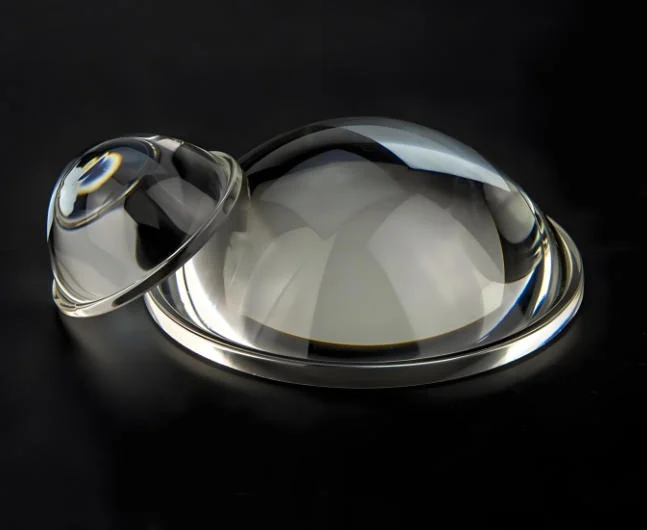
Fused Silica Aspherical Lens Product Description
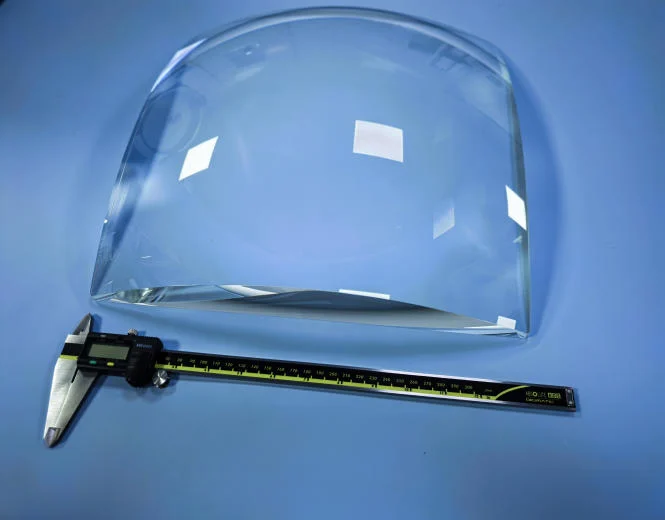
Asin Optics custom-manufactures fused silica aspheric lenses designed for zero spherical aberration, high numerical aperture, and compact optical paths. Utilizing processes such as CNC polishing, CNC machining, and Magnetorheological Finishing (MRF), we fabricate aspheric profiles on fused silica substrates, precisely controlling parameters such as aspheric coefficients, radii of curvature, and conic constants. These lenses are primarily used in applications including femtosecond laser micromachining, confocal microscopy, and deep-UV lithography illumination.
We use fused silica as the substrate material; UV-grade fused silica offers high transmission across the 185 nm to 2100 nm range, is fluorescence-free, and possesses a high laser damage threshold. A single aspheric lens can replace multiple spherical lenses, thereby enhancing system stability.
Why Choose Us For Your Fused Silica Aspherical Lens Project
- We manufacture aspheric lenses with diameters ranging from 5mm to 600mm, supporting plano-convex, bi-convex, and meniscus configurations; edge features such as steps, flats, or locating edges can be machined to specifications.
- We maintain strict wavefront control, achieving transmitted wavefront errors of less than λ/10 RMS @633nm, ensuring no degradation of the focused beam’s M² factor.
- We offer various coating systems tailored to customer requirements, including broadband anti-reflective (AR) coatings (UV to NIR), narrowband high-reflectivity coatings, and beamsplitter coatings.
- Both our fused silica substrates and coatings are produced to laser-grade standards; we provide high laser-damage-threshold coatings suitable for high-power continuous-wave (CW) or pulsed lasers.
- Typical numerical apertures (NA) range from 0.1 to 0.7; high-NA designs enable efficient collection and focusing of laser beams or fluorescence.
Fused Silica Aspherical Lens Metrology And Quality Assurance
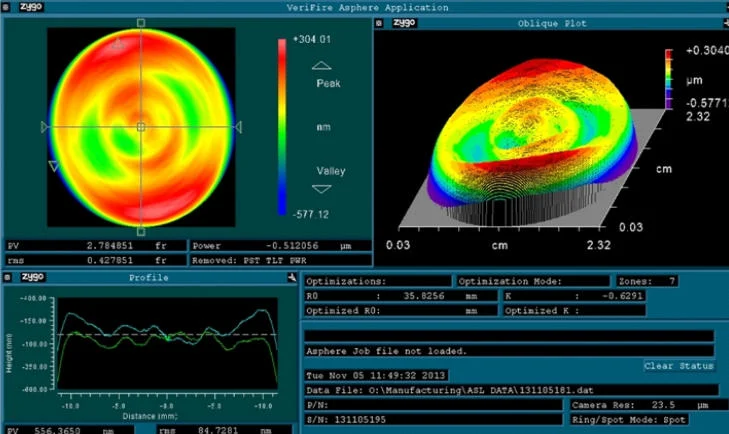
Custom Capability Technical Specification Of Fused Silica Aspherical Lens
Laser-Grade Aspheric Substrates Applications
High-Power Laser Focusing and Beam Shaping
In high-power fiber laser and excimer laser systems, aspheric lenses can focus beams to the diffraction limit. When used as focusing elements in laser cutting or welding heads—such as aspheric lenses for 1064 nm fiber lasers—a single element can correct on-axis spherical aberration. Combined with fused silica substrates (offering ultra-low bulk absorption) and high-damage-threshold coatings, these lenses ensure stability against thermal focal shift under kilowatt-level continuous-wave or pulsed operation. For UV excimer lasers, aspheric lenses employed in beam homogenization or mask projection units help minimize scattering losses.
Laser Beam Expanders and Collimators
In laser beam expansion and collimation systems, aspheric beam expanders provide superior aberration correction, yielding expanded and collimated outputs with minimal wavefront error. In fiber coupling applications, high-numerical-aperture (NA) aspheric collimating lenses accept divergent input beams and produce collimated output beams, thereby enhancing coupling efficiency.
Semiconductor Lithography
In semiconductor front-end processing, aspheric lenses used in wafer inspection leverage their specific surface profiles to increase the objective lens’s numerical aperture. These designs correct monochromatic aberrations in the DUV (Deep Ultraviolet) range, enabling dark-field or bright-field imaging capable of detecting nanoscale defects. Within the illumination systems of lithography machines, DUV-grade fused silica aspheric lenses can perform both beam shaping and homogenization functions using a single element.