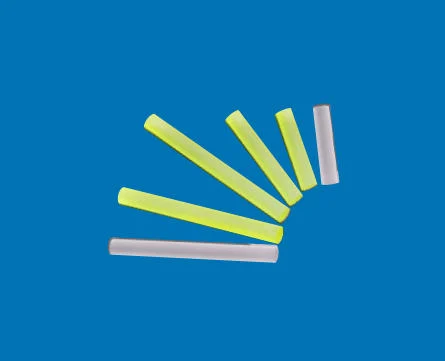
Gradient-Doped Nd:YAG Product Discription
Asin Optics customizes and manufactures gradient-doped Nd:YAG crystals for high-power laser systems
Gradient-doped Nd:YAG crystals are laser gain media specifically designed for high-power, high-repetition-rate solid-state lasers. By precisely controlling the axial or radial doping distribution of neodymium ions during crystal growth, they address the issues of gain concentration and heat accumulation found in traditional uniformly doped crystals.
Why Graded-Doped Nd:YAG Laser Crystal ?
- In traditional uniformly doped Nd:YAG crystals, the pump light is strongly absorbed near the surface or at the end faces, causing the end faces of the doped crystal to absorb excessive energy. This results in severe non-uniformity in gain and temperature along the crystal axis, leading to localized overheating.
- Our axially graded crystals enable uniform heat distribution along the axial direction, reducing thermal gradients and wavefront distortion.
Compared to traditional multi-element diffusion bonding, continuous gradient crystals have no physical bonding interfaces within the crystal. This completely eliminates scattering losses at interfaces and significantly increases the laser damage threshold, making them particularly suitable for ultrashort-pulse and high-energy nanosecond lasers. - In addition to supporting axial gradient customization, we also support radial gradient customization to achieve Gaussian or top-hat beams for picosecond pumping.
Asin Optics’ manufacturing capability of Gradient-Doped Nd:YAG Crystals
- We can precisely control the doping concentration profile, keeping concentration errors within a very narrow range.
- Using advanced CNC polishing and super-polishing techniques, we can achieve extremely high surface finish precision, thereby reducing scattering losses.
- We can provide inspection reports on surface profile using a Zygo interferometer.
Custom Capability Of Gradient-Doped Nd:YAG Crystals
Gradient-Doped Nd:YAG Crystals Applications
High Average Power DPSS Lasers
In conventional uniformly doped Nd:YAG crystals, under high-power pumping, the vast majority of the pump energy is absorbed within a few millimeters of the end face, resulting in extremely steep temperature gradients and severe thermal lensing effects. In end-pumped configurations, axially graded crystals are used, with the low-doped end facing the pump source. In side-pumped modules, radially graded crystals are employed, with a slightly lower concentration in the central region to facilitate heat dissipation, enabling compatibility with higher pump powers.
Medical & Aesthetic Laser Systems
In medical lasers such as long-pulse 1064 nm vascular treatments, Q-switched pigment removal, and picosecond skin rejuvenation, spot shape and energy density distribution are highly critical. In uniformly doped crystals, the thermal lens focal length continuously drifts during operation, causing variations in the output spot size and energy density of the treatment handpiece. Axially graded crystals are typically used, with the low-concentration end facing the pump diode array. This crystal is installed within the laser’s resonator or amplification stage and is fully mechanically compatible with standard-sized Nd:YAG rods, ensuring treatment consistency and extending component lifespan.
Military & Scientific Research
In applications such as high-energy laser weapons, laser ranging/designation, infrared countermeasures, ultrafast laser amplification, quantum optics, and gravitational wave detection, solid-state lasers must operate stably under extreme temperatures. Under such conditions, uniformly doped crystals suffer from worsening birefringence and wavefront distortion, which can lead to crystal fracture. In slab or thin-slab laser amplification chains, the use of custom two-dimensional concentration gradient crystals enables precise coupling between the pump absorption and cooling paths. This allows the laser to maintain stable beam alignment in both extremely cold and extremely hot environments.