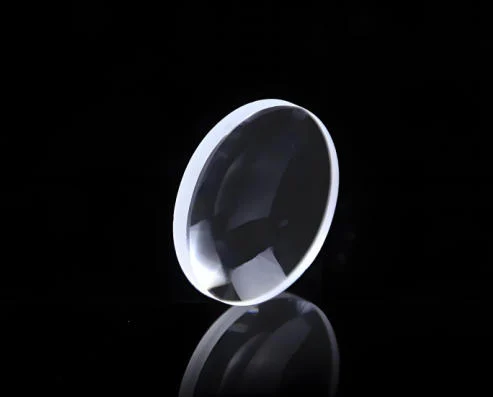
High Damage Threshold Fused Silica Plano-Convex Lenses Product Discription
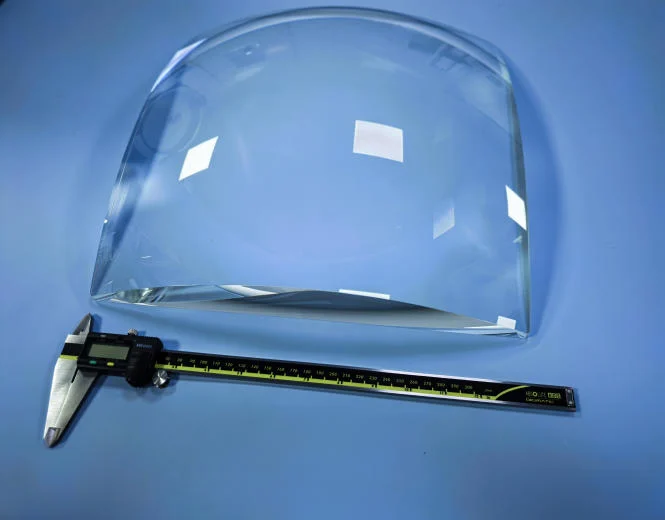
Plano-convex lenses are optical components featuring one spherical surface and one flat surface, primarily used for laser focusing, fiber coupling, and beam collimation. Asin Optics custom-manufactures high-damage-threshold fused silica plano-convex lenses. By utilizing ultra-pure UV-grade fused silica combined with precision polishing and high-damage-threshold processing techniques, these lenses maintain extremely low absorption and excellent thermal stability when focusing or collimating high-power laser beams.
What Other Spherical Lens Do We Provide
For spherical lenses, we offer plano-convex lenses, biconvex lenses, plano-concave lenses, and biconcave lenses.
We offer the following spherical lens types: plano-convex, biconvex, plano-concave, and biconcave.
- Calcium Fluoride (CaF2): plano-convex, biconvex, plano-concave, and biconcave lenses.
- Magnesium Fluoride (MgF2): plano-convex, biconvex, plano-concave, and biconcave lenses.
- Silicon (Si): plano-convex, biconvex, plano-concave, and biconcave lenses.
- Zinc Selenide (ZnSe): plano-convex, biconvex, plano-concave, and biconcave lenses.
- Zinc Sulfide (ZnS): plano-convex, biconvex, plano-concave, and biconcave lenses.
- Barium Fluoride (BaF2): plano-convex, biconvex, plano-concave, and biconcave lenses.
How Is Our Thin Film Coating Capability For Laser-Grade Fused Silica Lenses
We can provide coatings with high laser-induced damage thresholds tailored to customer requirements, covering key laser wavelengths ranging from the ultraviolet to the near-infrared:
- 355 nm
- 532 nm
- 1064 nm
- 2940 nm
- Or broadband (BBAR) coatings for the 400–700 nm and 700–1100 nm ranges.
Our Core Technical Advantages Of Custom Focal Length Fused Silica Lenses
- Featuring UV-grade fused silica substrates and proprietary coatings, these optics offer a typical damage threshold exceeding 40 J/cm² (1064 nm, 10 ns), ensuring durability in high-power Nd:YAG, fiber, and UV laser systems.
- High-purity fused silica is used to maintain high transmission across the deep-UV to near-IR range (185 nm–2.1 µm), while the high-purity synthetic material minimizes laser-induced fluorescence background.
- Precision polishing achieves a transmitted wavefront of λ/6, with custom specifications available upon request.
Custom Capability Of Laser-Grade Fused Silica Lenses
High LDT AR Coated Spherical Lenses Applications
High-Power Fiber Laser Cutting
Fiber laser cutting and welding involve extremely high power densities, requiring focusing lenses to withstand prolonged exposure to continuous-wave (CW) power in the kilowatt range or pulsed power in the ten-kilowatt range. Fused silica offers an exceptionally low bulk absorption coefficient and a thermal expansion coefficient approximately one-tenth that of ordinary glass. When combined with high-damage-threshold coatings, it maintains stable refractive properties, ensuring a stable focal position and consistent cut quality during tens of hours of continuous processing.
Nd:YAG (1064nm) and Er:YAG (2940nm) Aesthetic Laser Handpieces
For Nd:YAG (1064nm) long-pulse or Q-switched lasers and Er:YAG (2940nm) fractional or ablative lasers, fused silica plano-convex lenses utilize high damage thresholds for focusing. They minimize stray light and ensure uniform beam profiles, thereby guaranteeing safe and effective treatment outcomes.
Laser Beam Expansion and Collimation
Laser beam expansion and collimation require the coordinated use of multiple lenses and demand high standards for wavefront quality and transmission uniformity. Fused silica offers high transmission from the deep ultraviolet (DUV) to the near-infrared (NIR) spectrum; it focuses the incident laser beam onto a spatial filter pinhole before recollimating the output, resulting in an expanded and uniform beam profile.
Deep UV Lithography and Semiconductor Process Inspection Instruments
Deep UV wavelengths—such as 248nm and 193nm—carry high photon energy; in such environments, other optical glasses suffer from reduced transmission and are prone to fluorescence. Fused silica is a material capable of maintaining high transmission and resisting fluorescence over long periods in DUV environments. Fused silica lenses serve as homogenization or beam-shaping elements in lithography illumination systems, or as high-NA (numerical aperture) focusing and imaging components in inspection instruments.