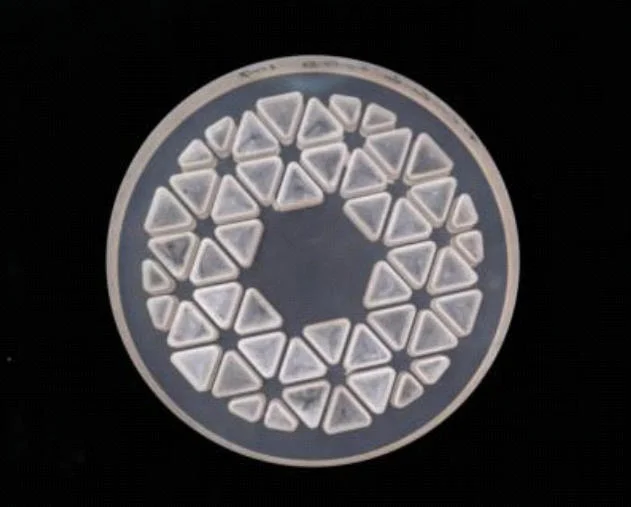
Zerodur Coaxial Paraboloid Mirror Product Discription
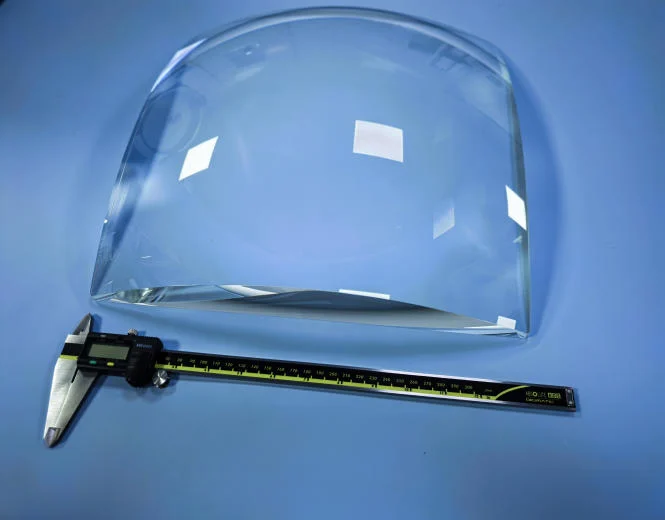
The Zerodur coaxial paraboloid mirror, also known as a Zerodur parabolic reflector, is manufactured using a high-stability Zerodur substrate. The parabolic reflector focuses axial parallel light to a single focal point without spherical aberration, and converts a point source into a parallel wavefront free of aberrations. With Zerodur glass-ceramic as the substrate, it maintains surface figure accuracy and optical axis alignment in environments with temperature fluctuations.
Zerodur Coaxial Paraboloid Mirror Product Key Advantage
- Zerodur microcrystalline glass, used as the substrate material, has an extremely low coefficient of thermal expansion, enabling it to maintain precise optical alignment even under significant fluctuations in ambient temperature.
- Coaxial parabolic mirrors are free of spherical aberration and chromatic aberration, ensuring a sharp spot while eliminating phase delay and transmission loss.
- The reflective design ensures uniform reflectivity across all wavelengths, maintaining excellent optical performance from the ultraviolet to the far-infrared spectrum.
- We offer a variety of metal and dielectric coatings to meet the application requirements of different wavelength bands.
- We can customize products according to customer drawings, including aperture, focal length, radius of curvature, center hole, edge chamfer, coating type, and more, and provide corresponding inspection reports.
Zerodur Coaxial Paraboloid Mirror Product Custom Capability
Why Choose Asin Optics For Your Parabolic Reflector
- Our Zerodur substrates are processed using the same high-precision equipment as other optical glasses for cutting, grinding, and polishing.
- Every Parabolic Reflector product undergoes rigorous interferometric and surface profile testing prior to delivery to ensure that its optical performance meets the customer’s technical requirements.
- We offer a one-stop service covering design, fabrication, and coating. Whether for standard off-axis parabolic mirrors or specific custom solutions, we possess extensive engineering expertise and production capabilities.
- Other materials we support include ULE ultra-low expansion glass, fused silica, standard optical glass (BK7, Pyrex), aluminum alloy, nickel-plated aluminum substrates, copper, silicon, and silicon carbide (SiC).
Zerodur Coaxial Paraboloid Mirror Applications
- Space Telescopes for Astronomical Observation
Conventional mirrors are susceptible to temperature fluctuations, which can cause mirror deformation and focal length drift, thereby compromising the resolution and positioning accuracy of deep-space imaging. When installed as primary or secondary mirrors in the optical path of an astronomical telescope, Zerodur coaxial parabolic mirrors can withstand environmental temperature changes while improving light-gathering efficiency - High-Power Laser Systems
Ultrashort-pulse lasers generate dispersion when passing through transmission lenses, causing pulse broadening. After passing through a Zerodur laser parabolic mirror at the laser output, the beam is focused or collimated via off-axis reflection. The Zerodur laser parabolic mirror can directly reflect all wavelengths and simultaneously focus them, maintaining the width of femtosecond pulses. - Spectroscopic Instruments
Conventional spherical mirrors or lenses introduce spherical aberration, reducing the spectrometer’s resolution. Large-aperture coaxial parabolic mirrors can efficiently collect faint signals and collimate them onto the grating, improving the signal-to-noise ratio and wavelength accuracy.