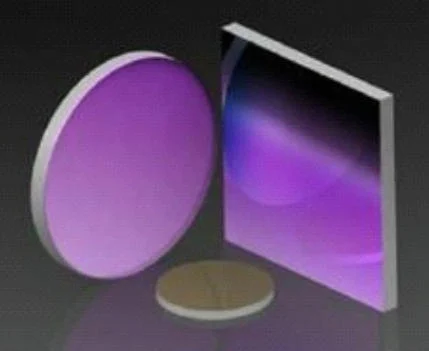
What DUV NUV Wavelength Thin Film We Are Working On?
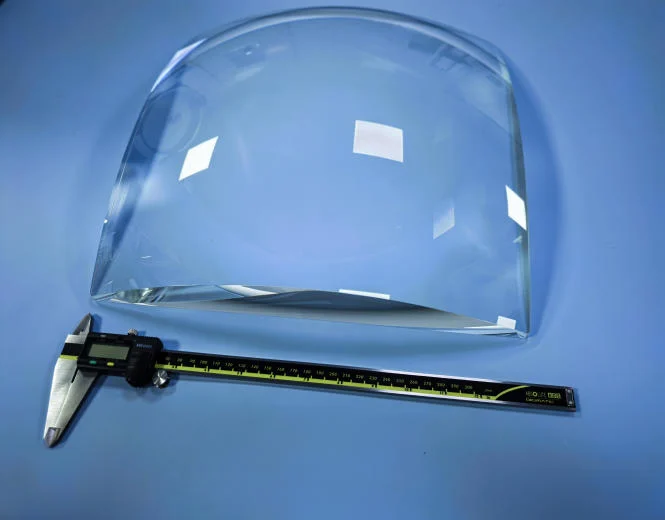
We provide UV coating services for a wide range of optical components (optical windows, lenses, prisms, mirrors, filters, beam splitters, parabolic mirrors, and lightweight structural components). We specialize in the design and production of high-performance coatings for the deep-ultraviolet (UDV) 180–300 nm and near-ultraviolet 300–400 nm wavelength bands. In addition to basic coating services, our coating solutions also offer high laser damage thresholds and long-term environmental stability.
What Substrate Do We Provide For DUV、EUV Thin Film Coating
Currently, we support coating on the following substrates:
- Fused Silica
- Qutartz
- Calcium fluoride
- Magnesium fluoride
- Sapphire
- Glass-ceramic
- K9, etc.
What Kind Of Thin Film Coating Do We Ultilize On The components
Based on our customers’ specific applications and requirements, we currently offer a variety of coating designs for the ultraviolet (UV) spectrum, including:
- Single-wavelength or broadband anti-reflection coatings: Designed for specific UV bands or laser wavelengths
- High-reflection coatings: Designed for key laser wavelengths such as 193 nm, 248 nm, 266 nm, and 355 nm, with reflectance levels reaching 99.8% to 99.99%.
- Dichroic mirrors and filters: Short-pass, long-pass, and bandpass UV filters
Typical products include:
- 355nm AR coating
- 266nm high-reflection mirror
- 193nm laser optics coating
- 248nm excimer laser filter.
High LIDT Laser Optics Thin Film Coating in DUV NUV Range
In the ultraviolet (UV) region, laser energy is high, and coatings are highly susceptible to burn-through due to absorption and defects. Through specially optimized designs and processes, we provide coatings with high laser-induced damage thresholds (LIDT) that can withstand the high peak laser power of UV pulsed lasers. Our high-LIDT coating services are built on advanced coating design, strict process control, and rigorous quality inspection.
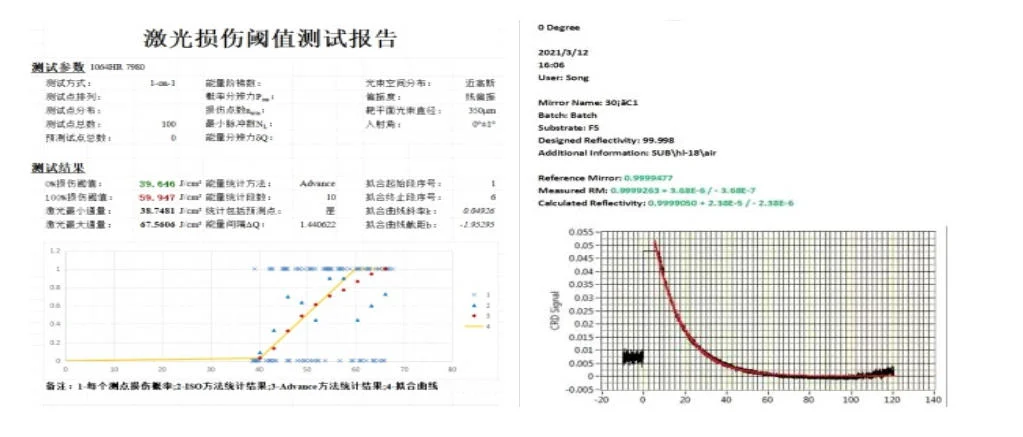
Laser-induced damage threshold (LIDT) is the most critical performance metric for UV coatings. We provide clear, test-data-backed LIDT values, rather than theoretical estimates.
Optical Thin Film Coating in DUV NUV Range Methology
We maintain strict quality control throughout the manufacturing process:
- We employ a multi-stage precision cleaning process—including ultrasonic, megasonic, and wiping techniques—to remove submicron particles and organic residues without damaging the polished surface. Each substrate is inspected under intense dark-field illumination prior to coating to ensure zero visible defects.
- Our polishing equipment ensures a substrate surface roughness typically ≤ 0.2 nm RMS. This ultra-smooth surface suppresses the localized field enhancement effects that cause laser damage.
- We use ultra-high-purity, UV-grade coating materials and precisely control deposition conditions to maintain an ideal stoichiometric ratio, thereby avoiding defects such as oxygen vacancies.
- We employ IBS and IAD coating processes. Films deposited using the IBS process exhibit no spectral drift under varying temperature and humidity conditions. The IAD process delivers dense, high-hardness films with excellent adhesion and outstanding environmental stability.
- We utilize top-tier spectrophotometers to provide full-bandwidth (185 nm–400 nm) and full-angle transmittance/reflectance scans, with a dynamic range exceeding OD 6 and a resolution as low as 0.01%. We also provide actual test curves as part of our delivery reports.
High LIDT Laser Optics Thin Film Coating in DUV NUV Applications
-
Lithography Systems and Wafer Defect Detection
In 193 nm (ArF) and 248 nm (KrF) deep-ultraviolet lithography systems, even the slightest absorption by any lens element is converted into heat, causing surface distortion and directly compromising the wavefront accuracy of the projection objective. Ion beam sputtering (IBS) technology is used to fabricate high-reflectivity coatings for 193 nm/248 nm applications, achieving reflectivity >99.8% while keeping absorption and scattering losses below 0.1%. Combined with stress compensation technology, this ensures that large-size lenses maintain a surface flatness accuracy of better than λ/10 after coating, guaranteeing diffraction-limited performance for the entire system.
-
PCB Drilling and Micro-Marking
In the resonator, beam expansion, scanning, and focusing optical paths of 355 nm solid-state UV lasers, optical components are continuously subjected to high-peak-power, high-repetition-rate UV pulses. Conventional coatings, due to high absorption or high defect density, are highly prone to coating burnout, reduced reflectivity, or beam distortion within a short period. We provide broadband 355nm anti-reflection coatings (transmittance >99.8%) to maximize UV energy utilization; simultaneously, the IAD process ensures coating hardness and environmental stability, withstanding humidity and temperature fluctuations in industrial environments.
-
Excimer Laser Equipment
In UV excimer laser treatments such as refractive eye surgery and cardiovascular interventions, optical components must remain absolutely stable under high-peak-power 193 nm/248 nm UV radiation; any coating delamination or volatilization poses a risk to patients. Coating 193nm/248nm high-LIDT cavity mirrors and window coatings using ultra-clean processes, and passing rigorous MIL-C-48497A adhesion and environmental testing, eliminates the release of any volatiles or particles.